With his philosophy, Whitehead aimed to “frame a coherent, logical, necessary system of general ideas in terms of which every element of our experience can be interpreted.” How is this possible? How can our experience of physical matters, like our touch of a stone or a bar of steel, our smell of a flower, and our feeling of truth and falsehood, goodness and evil, beauty and ugliness, as well as our experience of health and sickness, our experience of religions, including their different forms and traditions, and the different branches of science, etc., be subjected to the same scheme of interpretive principles?
With respect to this issue, Whitehead argued that “the primary method of philosophy is descriptive generalization.” He further explained this method of philosophy with his famous metaphor of the flight of an aeroplane: ”It starts from the ground of particular observation; it makes a flight in the thin air of imaginative generalization; and it again lands for renewed observation rendered acute by rational interpretation.”
That is, for him, the method of philosophy can be described as a way of imaginative construction, which has to be undertaken under strict conditions. “In the first place, this construction must have its origin in the generalization of particular factors discerned in particular topics of human interest”, such as in physics, in physiology, or in psychology, aesthetics, etc. Then, “the success of the imaginative experiment is always to be tested by the applicability of its results beyond the restricted locus from which it originated.” In this way, “the partially successful philosophic generalization will, if derived from physics, find applications in fields of experience beyond physics.”
Therefore, it can be properly said that the whole edifice of the process philosophy is based on this method of imaginative generalization and construction, which means “the utilization of specific notions, applying to a restricted group of facts, for the divination of the generic notions which apply to all facts.”
Both philosophy and religion aim to give an answer to the question concerning the ultimate nature of reality. While the answer of religion simply requires belief, somewhat like a bold leap into the darkness, the answer of philosophy has to be understood and tested in a rational way. As Whitehead had put it, it has to be ”a coherent, logical, necessary system of general ideas in terms of which every element of our experience can be interpreted.”
So, the emphasis here is put on “a system of general ideas”. And Whitehead had managed to come up with a system of general ideas, including those with respect to actual entity, prehension, eternal object, God and its primordial nature and consequent nature, etc. However, a person who does not specialize in philosophy, especially the one elaborated by Whitehead, may raise the question: how can I know?
This is a critical question. According to Whitehead, all our experience, that is, “everything of which we are conscious, as enjoyed, perceived, willed, or thought, shall have the character of a particular instance of the general scheme.”
If so, how can I know that “actual entities are the final real things of which the world is made up”? He said that these actual entities are drops of experience, complex and interdependent. If this is true, how can I experience it, and as a result, know it? After all, knowing has to be based on a certain form of experiencing.
It can be argued that Whitehead himself had reached these understandings through his personal powerful cognitive capacity and his lifelong work as scientist and philosopher. And he reached his understandings mainly through mental speculation.
The point is, can his findings, especially those core findings concerning actual entities, prehension, concrescence, and God be verified through the personal experience of everyone who has the interest to do so, or is it sufficient that these ideas remain as some interesting thoughts that exist only in the mind of Whitehead?
Whitehead obviously did not think the development of philosophy or metaphysics can occur only through speculation. It has to be able to have some impact upon our practical experience and go through its test: the aeroplane has to “land for renewed observation.”
The question is, how can our experience be interpreted according to the Whiteheadian philosophy?
For this purpose, the concept of Qi and its circulation which is of critical importance in the philosophy of Taoism can be very helpful. What’s more, I would like to argue that most probably the experience of Qi and its circulation can turn the Whiteheadian philosophy into an empirical scholarship whose scheme of ideas can be tested by the personal experience of each person who is interested to do so. Accordingly, philosophy will attain the same status as that of physics or any other branch of science which relies upon the test of their application in real life for their continual development.
In addition to that, philosophy and the different branches of science will find a new bondage with each other so that the transformation of human life and human consciousness and the development of scientific research fuel each other powerfully.
By contrast with process philosophy, Taoism is far more empirical than speculative. It is based on our personal experience, especially through the practice of meditation.
Whitehead wishes to develop a general scheme of ideas under which all our experience as enjoyed, perceived, willed or thought can be interpreted. By contrast, Taoism does not aim to simply “interpret”. It understands the cosmos as a process of evolution based on the functioning of Tao. I would argue the concept of Tao is comparable with that of God in Whiteheadian philosophy.
According to Chapter 42, Tao Te Ching, “Tao begets one, one begets two, two begets three and three begets myriad forms of beings. All forms of beings carry Yin and Yang and are harmonized through the mediation of Qi.”
This chapter obviously points to an evolutionary cosmology, under which the cosmos is a ceaseless and infinite process of evolution. What “one”, “two” and “three” here mean is not very clear. I believe “one” could be interpreted as Qi, which is considered as the ultimate component of the cosmos. Zhuangzi (c.369 BC-c.286 BC), one of the two founders of Taoism in addition to Laozi, said “the whole cosmos is nothing but Qi. Life is the condensation of Qi and death is the dissipation of Qi.”
It would be inspiring and helpful to regard Qi as the counterpart of actual entity in Taoism. Like actual entity, Qi is not physical entity. We can only experience Qi through its flow, its movement. As a matter of fact, we can experience nothing without Qi, as without Qi or when Qi is weakened to a certain level, we die.
It would be very suitable to define Qi as “drops of experience”, as Qi is what we need to experience. We can even say we are ourselves Qi in a structured way.
There is prevailing opinion that “two” means Yin and Yang. Yin and Yang are two basic movements of Qi, with Yin as the tendency of condensation, which is the process of physical formation, and Yang as the tendency of dissipation, which is the development of consciousness.
According to Whitehead, an actual entity is essentially dipolar, with its physical and mental poles. The mental pole originates as the conceptual counterpart of operations in the physical pole. The two poles are inseparable in their origination.
We could say Yin is the physical pole of Qi and Yang is its mental/conceptual pole.
Yin and Yang can be experienced by each of us through the practice of meditation. They are not simply the product of imagination, but are findings that are gained through observation that is rendered acute by rational interpretation.
According to Taoism, Yin and Yang are represented by two major meridians in the body: the Ren meridian and the Du meridian. The Ren meridian goes from the chin downward along the chest, the belly to the perineum, while the Du meridian goes from the perineum upward along the spine, to the back neck and the head top (Baihui acupoint), then downward along the nose to the philtrum. The Ren meridian and the Du meridian form a circle.
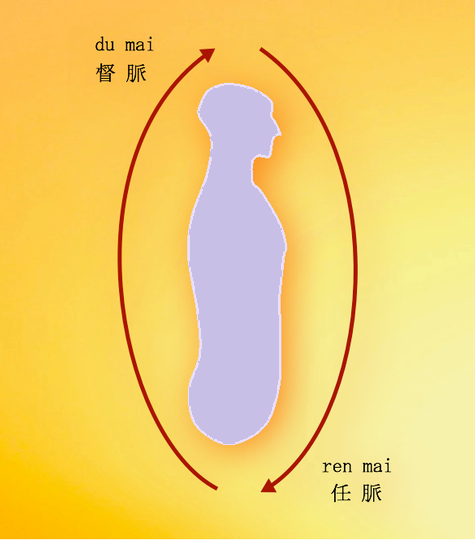
Ren means “pregnancy”. That is, the Ren meridian is responsible for the accumulation of Qi, which nourishes the body and is important for reproduction. It sustains the maintenance and development of the physical body. Accordingly, it’s the major Yin meridian.
Du means “leadership”. The Du meridian is responsible for the consumption of Qi, transporting Qi up to the brain for its work and development. It is of critical importance for the development of our consciousness. Accordingly, it’s the major Yang meridian.
The circulation of Qi along the circle formed by the Ren meridian and the Du meridian is always there. It determines the basic rhythm of our life, like outbreathing and inbreathing, awakeness and sleeping, etc. Normally we don’t experience this circulation of Qi, unless we start to practice meditation with the awareness that there is such a circulation.
People who practice meditation that is based on the Buddhist philosophy, like Zen meditation, vipassana, mindfulness, etc., normally don’t experience the circulation of Qi, even when they have practiced for more than 10 years. This is because what we can experience in our practice of meditation is determined by our understandings about life and the cosmos. There is no concepts of Yin and Yang and their circulation in the philosophy of Buddhism. Its focus is more placed on the experience of impermanence. With such mental state, the inherent pattern of energy circulation can not be discerned and fostered in a reliable way. Rather, its momentum will be ignored and suppressed.
For many people, the flow of Qi or life energy is actually their daily experience. It takes only a small step for them to imagine that there is such a circulation in the body. But for this small step one needs a whole philosophy and cosmology to make it meaningful.
In my personal case, I started to practice meditation according to the Taoist tradition around 11 years ago, for the purpose of healing myself from non-hodgkin lymphoma and some other chronical problems. I soon experienced the flow of Qi, and then its circulation. With the progress of the experience of Qi and its circulation, all the chronical problems have been fully healed and the lymphoma never deteriorated, without using any medicine, including chemical medicine and herbal medicine.
It seems to me that the Buddhist philosophy is more focused on the interrelatedness and interpenetration of the whole universe, instead of emphasizing its evolution, which, however, is a key principle of the process cosmology.
This evolution of the cosmos is achieved through the evolution of the actual entities in the form of prehension. Again, here the experience of Qi and its circulation can be very helpful for the understanding of the concept of prehension.
According to Whitehead, the essence of an actual entity consists solely in the fact that it is a prehending thing and its is constituted by its prehensions. There are physical prehension and conceptual prehension.
With intensified experience of Qi and its circulation through the practice of meditation, we can somehow experience how the process of prehension, including physical prehension and conceptual prehension occurs in a personal and direct way. When I have practice meditation for some years, I find that my experience of eating and reading changes.
When I ate something, like an apple, or a kiwi fruit, before I started to practice meditation, the experience of eating basically stayed in the area of my mouth and my tongue. It could be tasty or not. The rest of my body experienced very little from my eating. However, after some years of the practice of meditation, I can feel that with the eating of a fruit, the energy circulation in me is immediately strengthened. And now I can tell the quality of the food according to the strength and quality of the energy flow that it triggers in me. If the experience is strong and balanced, the food should be good quality, like organic vegetables and fruits. If the experience is weak and not balanced, the food is not that good in quality, like over-processed food.
I tend to think of my body as a circulation of energy. When I eat, that is, “prehend” some food, if the food is good in energy, my circulation will be directly strengthened with it. All the actual entities in that food will become the components of my body. Not like the normal understanding of digestion according to biology, I do not simply take over the nutrients from the food into my body, but the energy of the food is merged into the circulation of Qi in me and strengthen it: “many become one and is increased by one.”
The process of conceptual prehension, that is, prehension of eternal objects, can also be understood in a similar way. That explains why I’m enthusiastic about the study of process philosophy and taking the courses offered by the Cobb Institute. The speculative cosmology developed by Whitehead, together with its major concepts, including actual entities and its mental pole and physical pole, prehension, concrescence, God and its primordial nature and consequent nature, sounds to me resonant very well with my experience of meditation. When I read about them, or feel that my experience is beautifully interpreted in the course, I can feel that the circulation of Qi in me is greatly activated and strengthened. It seems to me that these concepts can be understood as eternal objects. When they are “prehended”, they become the constituting components of my consciousness, and strengthen the circulation of Qi in me.
As for the concept of God and its primordial nature and consequent nature, as God is an actual entity according to Whitehead, we can also directly experience it through the experience of Qi and the practice of meditation. The concept that is comparable with God in Taoism is of course the concept of Tao, which is said by Mencius (BC 372-BC 289), another founder of Confucianism in addition to Confucius, to go together with Qi. That is, if one can experience the flow of Qi deeply, he is coming close to Tao.
With the concept of God, Whitehead tries to pinpoint the permanence of things, in addition to the notion of the flux of things. Indeed, it’s the same with Tao in Taoism. According to Tao Te Ching, Tao is totally permanent. It never changes. At the same time, it is productive and is the mother of all the elements and beings in the universe.
On the other hand, both God and Tao can be described as the concept of emptiness in Buddhism. Emptiness is permanent, but it is the permanent source of creation and novelty.
This can also be experienced in the circulation of energy through the practice of meditation. We sink into emptiness when we practice meditation. However, it’s exactly in this emptiness of meditation, we experience the flow of Qi and its circulation, the source of life in the universe. With that, we grow and heal ourselves from various kinds of physical and mental problems.
And I would even argue that with this experience of Qi and its circulation through the practice of meditation, we can also free ourselves from declining due to aging. Life will no longer be a process doomed to end and die. According to the cosmology of process philosophy, actual entities are the final real things of which the world is made up. So each of us as human being are also made up of actual entities.
That means, if we can personally experience this fact through the experience of the circulation of Qi in us, we will share the same capacity of an actual entity that keeps evolving through the interaction of its physical pole and mental pole. The point is that we need to become more and more aware of this and turn our life into a continual process of prehension, so that all the food we eat and all the ideas and knowledge we learn can be organically merged into the circulation in us and have it increased. This process should be able to go on forever, and there seems to me no reason that it will be prevented and stopped by some unsurmountable barriers.
I would say this process of human evolution is the final reality of the universe, as the human being is the highest exemplification of its principles. With this in mind, the task of the different branches of science is no longer to find the final truth, but to foster the interrelationship between the human beings and the universe, so that the ongoing evolution of each individual and the mankind as a whole can occur efficiently, peacefully and successfully.
Actually this is exactly the ideal of Confucianism since its very beginning. According to Da Xue, or the Big Learning, one of the founding works of Confucianism, the lifelong journey of a person shall be “If one wishes to bring peace to the world, one has to first bring peace to his kingdom; if one wishes to bring peace to his kingdom, one has to first bring peace to his family; if one wishes to bring peace to his family, one has to first cultivate his personality/body; if one wishes to cultivate his personality/body, one has to first make his mind upright; if one wishes to make his mind upright, one has to first to be true and honest; if one wishes to be true and honest, one has to first know the true reality; if one wishes to know the true reality, one has to have direct experience.”
With this ideal, the cultivation of one’s personality and body, the attainment of knowledge and the service for the peace of the world are not separate or conflicting tasks, but are mutually conditioned upon each other. The scholars of Confucianism in the history all had tried to shed more light on this ideal. With the insights from process thoughts and the ongoing development of knowledge in different branches of science, the preconditions for the true achievement of this ideal are ripening.
 meditationtaoist