Fresco by Bo Beskow for the Meditation Room in the General Assembly Building of the UN.
The practice of meditation is to become aware of the relatedness, the relatedness between mind and body, between all the cells in the body, between human beings, between human and nature, between human and the Cosmos.
Relatedness is the final and true reality of the Cosmos. All the events and all the elements in the Cosmos are related to each other and are one with each other. There is no separate event, no separate element, and no separate human being as well.
The separation is a passing impression, an impression in which our senses, especially the eyes tend to be trapped. With our eyes, all the things seem to be separate from each other. The mountain is the mountain, the river is the river, you are you, I am I, the head is the head, the arm is the arm.
If we take what we see through the eyes as the final reality, and fail to see the oneness of the mountain and the river, you and I, the head and the arm, our existence in the world will become more and more boring, more and more weakened. Various forms of pain will occur, and death becomes unsurmountable.
Because being trapped in a passing impression weakens the relatedness between each other, blocks the energy flow between each other and debilitate the life.
The energy is not tangible and measurable stuff. It’s simply the experience of the relatedness. It’s the evidence that the relatedness does exist and function.
To experience the fact that all the events, all the elements, including ourselves and the whole Cosmos as well are by their nature related to each other, we need to close our senses, our eyes, return to our being and consciousness as a whole, return to the meditation.
It’s the deepest longing of each life and each human being to become aware of our relatedness with the other beings, the nature and the Cosmos. We can even say that it’s exactly for the purpose of experiencing this relatedness that the life is born out of the nothingness.
Relatedness is the major theme of all the religions and spiritual traditions and the major theme of science and philosophy as well.
With the concept of God, Allah, etc. as the creator of the cosmos, monotheism such as Christianity, Islam, etc. hints at the oneness of the Cosmos, while Buddhism, Taoism and Confucianism hint at the oneness of the Cosmos with the concept of emptiness, nothingness, Tao, etc. Oneness reveals the fundamental interrelatedness of the Cosmos.
Modern science is deeply influenced by materialism so that it‘s difficult for many scientists to understand the inherent oneness and interrelatedness of the Cosmos. However, materialism also aims to find the final common basis of all the phenomena in the Cosmos so that their relationship between each other can be fully understood.
Scientists focus their research upon the particular phenomena and are inclined to be solely concerned with the phenomena. By contrast, religion and philosophy shift our concern back to the true nature of life and the Cosmos, in case we lose the consciousness that all the beings are one and related to each other actually.
Our pursuit of truth is about the forms, patterns and modes of the relatedness. Our pursuit of beauty is about the subjective experience of the relatedness. Both truth and beauty are relative and in flux constantly.
Due to our inherent nature of being related and one with the Cosmos, we long to experience this reality, and deepen our relationship with the Cosmos.
Accordingly there is this pursuit of goodness. Goodness is the balance between truth and beauty, the mediation between the objective and the subjective. The practice of meditation is our constant exploration of truth, beauty and goodness, so that we can step by step come close to the eternity, to the final reality of the Cosmos and our existence in the world.
As the year is coming to the end, it’s time to reflect upon what has occurred to us in the past year and what changes we have gone through. Life keeps flowing and changing, little by little. I wish I could keep a track of it, as life does not simply flow, but it strives to grow, like a tree. By keeping an eye on it, I can stay in tune with and consciously nurture its growth.
In the beginning of the past year I had two cases of intensive private tutoring of healing meditation. The clients, two women at their 60s, were both cancer patients. One is Mrs. Lv, who has lymphoma with bone metastasis, and the other one is Mrs. Long, with lung cancer.
Mrs. Lv had had several rounds of chemotherapy before she came to me. She could hardly move and had a lot of pain when the tutoring started. My work with her lasted for nearly 40 days and the training includes sitting meditation, standing meditation, walking, stretching, jogging, etc. Little by little her mobility improved and her pain was slowly alleviated. By the end of the tutoring she could jog slowly and walk in the mountain for half an hour. I hereby attach a video showing her change from April 24 to June 2.
Mrs. Long started practicing meditation under my instruction soon after she was diagnosed, without having any medical treatment, as her daughter in law had followed my wechat blog for more than 2 years. Her mother had lung cancer and died after many rounds of medical treatment. So she persuaded her husband and her mother in law to try a more natural and holistic way. Due to the serious epidemic situation in Shenzhen, I was invited to their hometown and gave the tutoring for the woman as well as her son, daughter and the daughter in law in March. I worked with them for 10 days. The woman had been a farmer all her life and was basically healthy. Her experience in meditation deepened quickly. By the end of the 10-day workshop, she already had strong feeling of Qi circulation in the body and really enjoyed practicing meditation. Before the workshop she had no movement except her labor as farmer. It was a great burden for her to jog in the beginning. By the end of the workshop she could already jog quite easily. After the workshop she attended my online meditation group. The group met two nights per week. She later started to take targeted medicine besides meditation. Now she jogs each morning for several kilometers and does rope skipping in addition to sitting meditation every day. Some weeks ago she reported that her tumor has shrunk from the size of an egg to the size of a small grape.
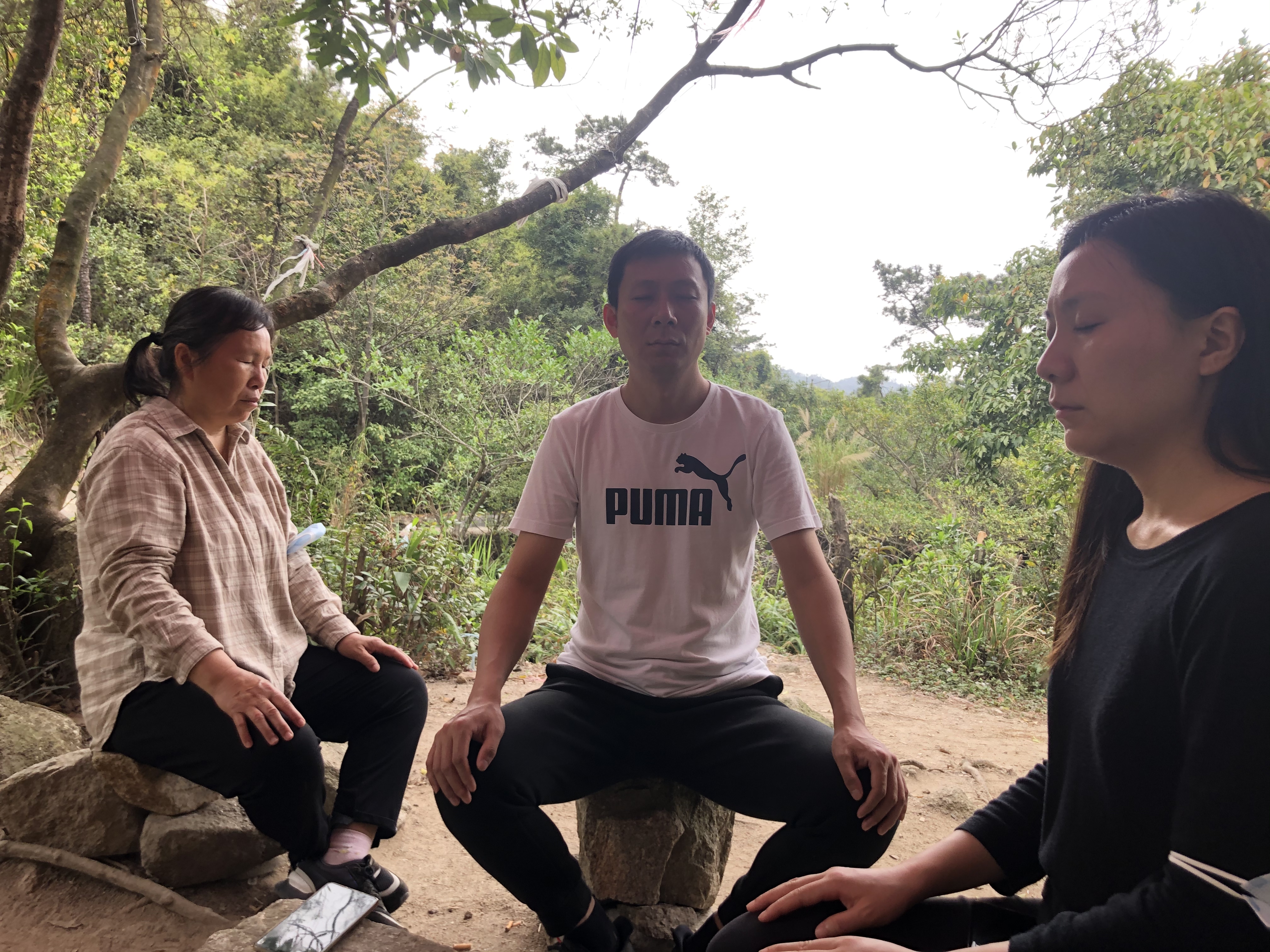
Mrs. Long and her son and daughter practiced meditation after walking as warming up.
There are other successful cases for healing cancer through meditation based on Taoism in the past year. They indicate the great significance of meditation for boosting the power of spontaneous healing in us. So meditation is not only for psychological benefits, and works only at the mental level. Rather, it directly relates to the function of the whole body and corrects any defects that are caused by our continuous neglect of our physical and mental state.
I have to point out that my understanding of meditation is based on Taoism and Confucianism, which have a cosmology that is different from modern science as well as from Buddhism. According to the cosmology of Taoism and Confucianism, the cosmos is not static, but keeps on evolving by its very nature. Ying and Yang are the two opposite, but mutually supporting and nourishing processes of energy flow which propels the evolution of the cosmos. As a result, myriad forms of life come into being. There is the same dipolar energy flow in us, which constitutes the circulation of Qi. If this circulation goes smoothly without interruption or suppression, we keep on evolving as an individual and remain healthy both physically and mentally. Or else we suffer various forms of emotional disturbance and become too weak to resist the harmful elements in the environment, including virus.
In the past year I have been trying to find in the western heritage of culture a philosophy or cosmology that is compatible with this one. I read some interesting books, such as Irrational Man by William Barrett (a knowledgeable book for existentialism), Einführung in die Philosophie (Introduction of Philosophy) by Karl Jaspers, Hegel by Frederick Beiser, Aristotle by Jonathan Barnes, etc. I realize that indeed there is a thread of intellectual development in the west which regards the cosmos as an organic process of evolution rather than a mechanical machine that runs according to some physical laws.
What’s more interesting is, in the last several months of this year, I found that the philosophy of Alfred North Whitehead is an even more marvellous elaboration of such a cosmology, which is a genius combination of strict scientific reasoning and talented imagination. There are many concepts in Whiteheadean philosophy which I like very much. First of all it argues for a one-substance cosmology, in which ‘actual entities’ are the final real things of which the world is made up. Actual entities are not physical objects like atoms, but ‘drops of experiences’. In addition to that, ‘creativity’ is the universal of universals characterizing ultimate matter of fact, which is also the inherent nature of each actual entity.
I haven’t had the time to explore the Whiteheadean philosophy deeply. I just took two courses given by the Cobb Institute in the US (The Cobb Institute) on the Whiteheadean philosophy and started to read some of Whitehead’s works, such as Process and Reality, Adventures of Ideas, etc. My first encounter with Whitehead is very enlightening and I will do more research.
In Process and Reality, Whitehead said:“Whatever thread of presupposition characterizes social expression throughout the various epochs of rational society must find its place in philosophic theory. Speculative boldness must be balanced by complete humility before logic and before fact. It is a disease of philosophy when it is neither bold nor humble, but merely a reflection of the temperamental presuppositions of exceptional personalities. By providing the generic notions philosophy should make it easier to conceive the infinite variety of specific instances which rest unrealized in the womb of nature.”
Such a cosmology that is compatible with modern sciences and also strives to reconcile them with our religious experience is exactly what I’m searching for. It makes the experience of Qi and the healing effect of meditation even more intelligible. And I believe it is philosophy, rather than particular branches of sciences, be it neurology, brain science or quantum physics, that provides the proper vehicle for understanding meditation and meanwhile the guiding principles for it.
In early December, I had the chance to give an online presentation in English with the title “Healing in a Chinese Process Way” at the Cobb Institute. 97-year-old Prof. John Cobb, Jr., one of the leading scholars on process philosophy in our time attended the presentation and gave very warm and affirmative comments. The recording has been uploaded to the online archive of the Cobb Institute and can be retrieved via this link: Meeting Recordings – 2022 | Cobb Institute.
By the date of Jan. 13, 2023, it will be totally 10 years since I first started to practice meditation for the purpose of healing my lymphoma. From the very beginning I decided to approach meditation in a scientific and rational way, so that the healing effect of meditation could be strictly tested and, if it does have such effect, its mechanism should be understood in an intelligible way. I have followed this approach strictly in the past 10 years and now I can say I have fully achieved the goal. Not only I have recovered from my lymphoma, as well as other chronic problems including prostatitis, atrophic gastritis, ankylosing spondylitis, etc. in a totally natural way, without using any drugs or therapies except sitting and moving meditation, but also I have helped a lot of people achieve the same result by sharing my experience with them. What’s more, I can now explain in a very practical and intelligible way why this is possible and how we can achieve it in a most reliable and efficient way.
In the presentation I said that a new story of life is possible when we can integrate the intellectual heritages of the West and the East. With that I mean a form of life that is not doomed to become more and more vulnerable as we slowly get older. There is an inherent driving force in each of us that continuously nourishes and leads the development of our life so that it keeps evolving as the cosmos does. Or we can even say the conscious evolution of each of us by itself is a cosmic event, as each of us is the particular embodiment of the cosmic process.
After 3 years’ of entanglement with the corona virus, we finally see the light of free movement in China again. People in the world have suffered a lot from the virus. However, as always in our life, suffering can be a call and an urge for evolution.
I wish you all merry Christmas and a healthy, peaceful and happy New Year!
Due to the Corona virus epidemic, it’s quite difficult for us to stay in contact and communicate with each other. Traveling out of China, which had been a great pleasure for me to visit old friends, to make new friends and experience foreign cultures, has become a big problem since the beginning of the epidemic. This is a great pity. Although communication through the Internet is now much easier than before, we miss the feeling of staying with each other physically.
As 2021 is coming to the end, I would like to share with you the change in my life and my new findings in the past year. This is my second year living at the foot of Wutong Mountain, which is located around a half hour by car from the center of Shenzhen in Guangdong Province, South China. I moved here from Beijing first because I wish to experience the natural environment and culture in South China, more south from my hometown in Zhejiang province after so many years living in Beijing.
It proves a very nice place. It has a subtropical climate with beautiful plants all the year, suitable for a meditation retreat in all seasons. I enjoy very much walking up the mountain, either along a broad cement way or along a narrow way paved with slates and along a crook full of pebbles and rocks. Its vicinity to Shenzhen, one of the most prosperous cities in China also contributes to its attraction to many people who come and live here engaging in activities concerning education, art, traditional medicine, culture, Qigong, Taiji, etc. Dining in any restaurants here you easily hear that people are talking about Buddhism, Taoism, Confucianism or traditional medicine, which is rare in other places in China. The local villagers are especially friendly, polite and peaceful, whether they are repairmen, storekeepers, cleaners or landlords. They seems to me enjoy their life quite much and there is nothing to complain about.
As before, I continue with the teaching and research of healing meditation, mainly for people with health problems, including cancer. However, I more and more realize that the benefit of healing is but one of the concurrent effects of my approach of meditation. Its true purpose is for a better understanding of life, of the meaning of being mankind on the earth.
People’s understanding of meditation in the west is mainly influenced by Buddhism, which, as it is normally understood, regards our life as doomed to perish and nothing is permanent. Accordingly, the best solution for the vulnerability and all the pains in life, including diseases and death is to relinquish our attachment to it by becoming conscious to the elusive and illusionary nature of existence (to be sure, this is an oversimplified summary and does not fully convey the true insights of Buddhism).
By contrast, Taoism and Confucianism regard our existence from a more optimistic perspective. For them, the cosmos by its inherent nature is a process of evolution with consciousness. Or more precisely, it strives to become conscious. The mankind is but the fruit of this permanent process of conscious-becoming. Therefore, although all the phenomenon, including our life, all our feelings are impermanent, there is a constant driving force engaging all these phenomenon as the evolution of the cosmos proceeds.
The same latent driving force propels the physical and mental development of each of us as human being, especially before we come to adulthood. After that, we often get too much stuck in our given or self-coined concepts of life and the world and are disconnected from this cosmic driving force, which leads to various forms of anxiety and worry, waning of energy and vulnerability to the environment. Disease and death ensue as a result.
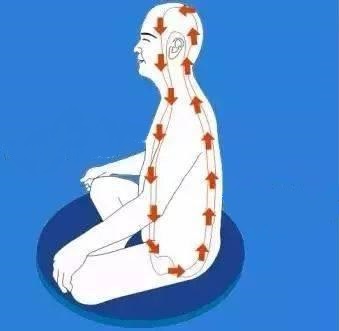
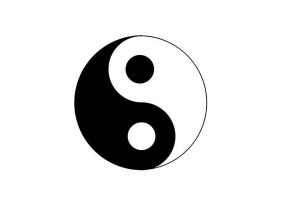
Therefore, the meaning of meditation is more than for us to become conscious of the elusiveness of all our senses and feelings. It’s the practice for us to be connected to the cosmic driving force again. By resting our mind, that is, striving to become more conscious of our body, our life, we can experience the strengthened flow of energy in us. Furthermore, we will find that the energy does not flow randomly, but in a circle in us, going down in the front and going up at the back, as indicated below. With that we can understand the Taiji symbol of Taoism, which depicts the nature of life and the cosmos as well: a process of evolution propelled by two opposite and mutually supportive, as well as mutually inclusive forces:
Through the practice of meditation, not simply in the form of sitting, but also including standing, moving, thinking, talking, etc. ( actually, any moment in our life could be a form of meditation), we stay in connection with the cosmic driving force and are open for continuing development and growth as a human being, which naturally heals and leads to true experience of freedom which can be renewed again and again.
Taoism focuses more on the cosmic dimension, while Confucianism focuses more on the human dimension. Actually, they both are like Yin and Yang, the two opposite, mutually inclusive driving forces of the cosmos that propels the development of the Chinese culture.
As Confucianism focuses more on the human dimension, it constitutes the main spiritual tradition that guides and shapes the development of the Chinese culture. Its core is about the development and evolution of the human being, which is the major theme of the Chinese culture. Our whole being, including body and soul, is not a given gift, but the fruit of our own work and effort. That’s why in the Chinese culture, people attach so much importance to education and success in this world, which could be nasty and harmful if the spiritual implication is forgotten and ignored.
On the other hand, it indicates that Taoism and Confucianism by themselves are very rational and totally compatible with the spirit and methodological concern of modern science and philosophy.
That is to say, Taoism and Confucianism are not dogmatic teachings or belief. They are the rational effort of Chinese people, especially those great thinkers in our history, including Confucius, Mencius, Zhu Xi, Wang Yangming, to name but some of the most known, to deepen our understanding of the meaning of being human. Therefore, as important spiritual traditions, they have never stopped developing and have been growing with the development of sciences and philosophy, as well as the enriching of the experience of mankind as a whole.
Such development does not remain at the intellectual or spiritual level, as in the Taoist and Confucianist tradition body and soul, or spirit can not be separated. They are inseparably connected to each other. At the individual level, any intellectual or spiritual development necessarily leads to the development of our physical dimension, while the well-being of our physical condition constitutes the basis of intellectual and spiritual development.
In the past months I’m very much inspired by the masterpiece work on the history of Chinese philosophy written by Qian Mu (1895-1990, Ch’ien Mu – Wikipedia) and on the comparison with Chinese philosophy and western philosophy by Mou Zongsan (1909-1995, Mou Zongsan – Wikipedia). In addition to that, I have started to read Hegel’s Enzyklopaedie der philosophischen Wissenschaften im Grundrisse (1830, Encyclopedia of the philosophical Sciences ) and Karl Jaspers’ Einfuehrung in die Philosophie (Introduction of Philosophy). Both of them resonates quite well with my understanding of Taoism and Confucianism, as well as meditation.
It’s a great pleasure for me know that Hegel mentioned in his preface to the third edition of Encyclopedia that it’s not enough for Christianity to remain as a belief. Belief is just the beginning, then it has to be guided and enriched by scientific and philosophic work. I believe the same applies to all the great spiritual traditions in the world. A firm belief that our existence in the world is meaningful is very important, but we also need to take some distance from our belief so that we could understand it better. Out of this distance there emerges a room for all of us from different cultures on earth can communicate and make friends with each other, come to a better understanding of each other and thus make our existence in this world more meaningful, more prosperous and full of hope.
The Web of Life written by Fritjof Capra (born in 1939, an Austrian-born American physicist, systems theorist and deep ecologist) is also very interesting and inspiring.
I look forward to more connection and communication between us in the coming year. I could be reached via my email: jinzhenbao@hotmail, or via facebook (Leo Zhenbao Jin), or linkedin (Zhenbao Jin)
Merry Christmas and best wishes for you and your family in the coming year!


 meditationtaoist