Dear friends,
Due to the Corona virus epidemic, it’s quite difficult for us to stay in contact and communicate with each other. Traveling out of China, which had been a great pleasure for me to visit old friends, to make new friends and experience foreign cultures, has become a big problem since the beginning of the epidemic. This is a great pity. Although communication through the Internet is now much easier than before, we miss the feeling of staying with each other physically.
As 2021 is coming to the end, I would like to share with you the change in my life and my new findings in the past year. This is my second year living at the foot of Wutong Mountain, which is located around a half hour by car from the center of Shenzhen in Guangdong Province, South China. I moved here from Beijing first because I wish to experience the natural environment and culture in South China, more south from my hometown in Zhejiang province after so many years living in Beijing.
It proves a very nice place. It has a subtropical climate with beautiful plants all the year, suitable for a meditation retreat in all seasons. I enjoy very much walking up the mountain, either along a broad cement way or along a narrow way paved with slates and along a crook full of pebbles and rocks. Its vicinity to Shenzhen, one of the most prosperous cities in China also contributes to its attraction to many people who come and live here engaging in activities concerning education, art, traditional medicine, culture, Qigong, Taiji, etc. Dining in any restaurants here you easily hear that people are talking about Buddhism, Taoism, Confucianism or traditional medicine, which is rare in other places in China. The local villagers are especially friendly, polite and peaceful, whether they are repairmen, storekeepers, cleaners or landlords. They seems to me enjoy their life quite much and there is nothing to complain about.
As before, I continue with the teaching and research of healing meditation, mainly for people with health problems, including cancer. However, I more and more realize that the benefit of healing is but one of the concurrent effects of my approach of meditation. Its true purpose is for a better understanding of life, of the meaning of being mankind on the earth.
People’s understanding of meditation in the west is mainly influenced by Buddhism, which, as it is normally understood, regards our life as doomed to perish and nothing is permanent. Accordingly, the best solution for the vulnerability and all the pains in life, including diseases and death is to relinquish our attachment to it by becoming conscious to the elusive and illusionary nature of existence (to be sure, this is an oversimplified summary and does not fully convey the true insights of Buddhism).
By contrast, Taoism and Confucianism regard our existence from a more optimistic perspective. For them, the cosmos by its inherent nature is a process of evolution with consciousness. Or more precisely, it strives to become conscious. The mankind is but the fruit of this permanent process of conscious-becoming. Therefore, although all the phenomenon, including our life, all our feelings are impermanent, there is a constant driving force engaging all these phenomenon as the evolution of the cosmos proceeds.
The same latent driving force propels the physical and mental development of each of us as human being, especially before we come to adulthood. After that, we often get too much stuck in our given or self-coined concepts of life and the world and are disconnected from this cosmic driving force, which leads to various forms of anxiety and worry, waning of energy and vulnerability to the environment. Disease and death ensue as a result.
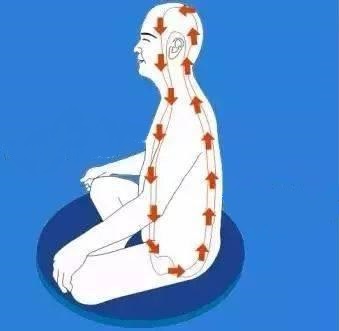
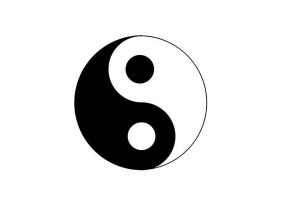
Therefore, the meaning of meditation is more than for us to become conscious of the elusiveness of all our senses and feelings. It’s the practice for us to be connected to the cosmic driving force again. By resting our mind, that is, striving to become more conscious of our body, our life, we can experience the strengthened flow of energy in us. Furthermore, we will find that the energy does not flow randomly, but in a circle in us, going down in the front and going up at the back, as indicated below. With that we can understand the Taiji symbol of Taoism, which depicts the nature of life and the cosmos as well: a process of evolution propelled by two opposite and mutually supportive, as well as mutually inclusive forces:
Through the practice of meditation, not simply in the form of sitting, but also including standing, moving, thinking, talking, etc. ( actually, any moment in our life could be a form of meditation), we stay in connection with the cosmic driving force and are open for continuing development and growth as a human being, which naturally heals and leads to true experience of freedom which can be renewed again and again.
Taoism focuses more on the cosmic dimension, while Confucianism focuses more on the human dimension. Actually, they both are like Yin and Yang, the two opposite, mutually inclusive driving forces of the cosmos that propels the development of the Chinese culture.
As Confucianism focuses more on the human dimension, it constitutes the main spiritual tradition that guides and shapes the development of the Chinese culture. Its core is about the development and evolution of the human being, which is the major theme of the Chinese culture. Our whole being, including body and soul, is not a given gift, but the fruit of our own work and effort. That’s why in the Chinese culture, people attach so much importance to education and success in this world, which could be nasty and harmful if the spiritual implication is forgotten and ignored.
On the other hand, it indicates that Taoism and Confucianism by themselves are very rational and totally compatible with the spirit and methodological concern of modern science and philosophy.
That is to say, Taoism and Confucianism are not dogmatic teachings or belief. They are the rational effort of Chinese people, especially those great thinkers in our history, including Confucius, Mencius, Zhu Xi, Wang Yangming, to name but some of the most known, to deepen our understanding of the meaning of being human. Therefore, as important spiritual traditions, they have never stopped developing and have been growing with the development of sciences and philosophy, as well as the enriching of the experience of mankind as a whole.
Such development does not remain at the intellectual or spiritual level, as in the Taoist and Confucianist tradition body and soul, or spirit can not be separated. They are inseparably connected to each other. At the individual level, any intellectual or spiritual development necessarily leads to the development of our physical dimension, while the well-being of our physical condition constitutes the basis of intellectual and spiritual development.
In the past months I’m very much inspired by the masterpiece work on the history of Chinese philosophy written by Qian Mu (1895-1990, Ch’ien Mu – Wikipedia) and on the comparison with Chinese philosophy and western philosophy by Mou Zongsan (1909-1995, Mou Zongsan – Wikipedia). In addition to that, I have started to read Hegel’s Enzyklopaedie der philosophischen Wissenschaften im Grundrisse (1830, Encyclopedia of the philosophical Sciences ) and Karl Jaspers’ Einfuehrung in die Philosophie (Introduction of Philosophy). Both of them resonates quite well with my understanding of Taoism and Confucianism, as well as meditation.
It’s a great pleasure for me know that Hegel mentioned in his preface to the third edition of Encyclopedia that it’s not enough for Christianity to remain as a belief. Belief is just the beginning, then it has to be guided and enriched by scientific and philosophic work. I believe the same applies to all the great spiritual traditions in the world. A firm belief that our existence in the world is meaningful is very important, but we also need to take some distance from our belief so that we could understand it better. Out of this distance there emerges a room for all of us from different cultures on earth can communicate and make friends with each other, come to a better understanding of each other and thus make our existence in this world more meaningful, more prosperous and full of hope.
The Web of Life written by Fritjof Capra (born in 1939, an Austrian-born American physicist, systems theorist and deep ecologist) is also very interesting and inspiring.
I look forward to more connection and communication between us in the coming year. I could be reached via my email: jinzhenbao@hotmail, or via facebook (Leo Zhenbao Jin), or linkedin (Zhenbao Jin)
Merry Christmas and best wishes for you and your family in the coming year!

Zhenbao/Leo, from Shenzhen, China, 12.24,2021
 meditationtaoist