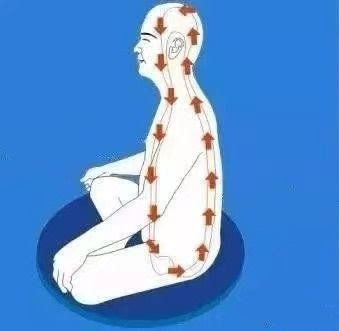
1. Qi’s Circulation as a Core Principle of Daoism/Taoism
By the time of January 13 this year, I have been practicing and researching meditation for exactly 13 years,starting from 2013. During these 13 years, I have developed a theoretical and methodological system of meditation centered around the circulation of Qi.
This system is compatible with Daoist, Confucian, and Buddhist thoughts, and also aligns with what I consider the pinnacle of Western philosophical tradition—process philosophy, epitomized by British mathematician, and philosopher Alfred North Whitehead (1861-1947). It can produce tangible results in practice, bringing continuous positive changes to the practitioner’s body and mind, thereby making it scientifically verifiable.
The direct theoretical basis for this approach of meditation comes from Daoist cosmology, namely a monism that exhibits a dual structure of yin and yang. The Book of Dao (or Tao Te Ching) states: “Dao begets one; one begets two; two begets three; three begets myriads of beings. Myriads of beings carry yin and yang, and are harmonized through the flow of qi.”
Qi descends along the front of the body, following the Ren meridian, representing yin, and ascends along the back, following the Du meridian, representing yang. Yin and yang are the two manifestations of the same process. They nurture each other, transform into each other and evolves together in endless cycles.
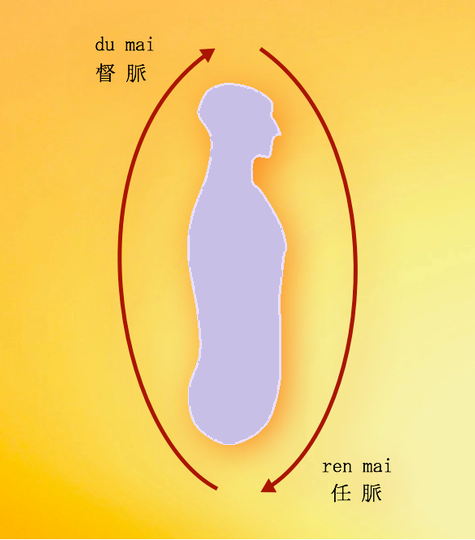
Qi’s circular flow is recorded in “Huangdi Neijing” (Yellow Emperor’s Inner Canon): “Qi can not stop moving. Just like water, it flows incessantly. Therefore, the yin and yang meridians nourish the organs and the bowels, like a circle that has no end, beginning anew after each completion. The flowing qi internally supports the organs and externally nourishes the skin and flesh.”
The Book of Dao does not describe qi circulation as explicitly as the Huangdi Neijing, but several classic paragraphs in it also point to the profound essence of life as a circulation of qi, for example:
- “Is the space between heaven and earth not like a bellows? Empty yet inexhaustible, the more it moves, the more it arises. Much speech leads to speedy exhaustion; it is better to preserve the mean. ” (Chapter 5)
- “Holding the spirit and the body together, can you maintain this without separation? Experiencing the circulation of qi to achieve softness, can you be like an infant?” (Chapter 10)
- “Reaching utmost emptiness, firmly maintaining stillness. The myriad things arise together; I thereby observe their return. Things are many; each returns to its root. Returning to the root is stillness, which restores the life. Restoring the life leads to the eternal. Knowing the eternal is enlightenment.” (Chapter 16)
- “The Dao functions through returning.” (Chapter 40), and so on.
2. Meditation approaches emphasizing circulation of Qi are strangely few.
Practically, the existing approach of meditation I am currently familiar with, which is centered on qi circulation, is Zhen Qi Meditation as founded by Li Shaobo (1910-2011) . This approach of meditation targets perceiving qi’s circulation from the outset and outlines five specific steps for practice guidance.
In my teaching, I do not segment into such specific steps. Instead, I guide learners to immediately enter a focused yet relaxed state, allowing them to naturally perceive changes in their breathing, body, and energy states, thus noticing qi circulation.
After thirteen years of practice and research, my meditation approach has evolved into a philosophical system, not just a set of qigong exercises. Consequently, it significantly differs from the Zhen Qi Meditation by Li Shaobo in terms of theory, method, and practical outcomes.
Dan Dao (Daoist alchemical practice) might also be rooted in qi circulation. However, I have not deeply studied or practiced Dan Dao, so I cannot comment on it.
In China, many practitioners teach the practice of opening the Ren and Du meridians, either for healing purposes or strengthening the body. However, no other approach seems to match Zhen Qi Meditation in terms of its public influence.
Not all qigong focuses on qi circulation. For example, although Guo Lin Qigong aims for healing and disease treatment and values qi sensation, it doesn’t place qi circulation at its core. Its “inhale-inhale-exhale” wind-breathing method might even hinder the experience of qi circulation. Despite this, Guo Lin Qigong can improve health and relieve symptoms in a short time.
The approaches of meditation as introduced by Jiang Weiqiao (1873-1958) and Nan Huaijin (1918-2012) , as well as the Zhineng Qigong by Pang Heming (1940-), do not center on qi circulation.
In late stages, both Jiang Weiqiao and Nan Huaijin turned towards Buddhist thought. Zhineng Qigong also values qi sensation but generally emphasizes the cultivation of consciousness.
Qigong can be considered the direct application of Daoist thought in practice. Yet, among numerous schools of qigong and Daoist practice, those centering on qi circulation are surprisingly few, which is quite puzzling.
The core of Buddhist thought is dependent origination and emptiness, which, at least on the surface, does not talk about yin and yang, nor emphasize the experience of qi or energy. Naturally, meditation systems based on Buddhist thought, such as Zen, Vipassana, and mindfulness, do not seek the experience of qi circulation. These systems are undoubtedly the mainstream of meditation in our time.
3. Factors that make it hard to focuse on the circulation of qi.
Given the importance of qi circulation to health, and as a significant aspect of Daoist thought, why hasn’t it been acknowledged by mainstream meditation systems? Based on over a decade of practice and research, I believe that consistently centering one’s practice on qi circulation is quite a challenging endeavor.
In this regard, the practice experience of Shi Huameng of the Shanghai Mental Health Center seems representative. Shi began learning meditation from a Daoist in primary school but did not understand the theories. At 17, he entered Wenzhou Medical University, majoring in clinical medicine, and practiced the Zhen Qi Meditation for several years without perceiving the circulation of qi.
Eager to be able to emit qi for healing purpose , he shifted to practicing Tongzhong Gong (a school of qigong), but after ten years, he still could not emit qi and subsequently switched to Confucian meditation. He now mainly practices according to the Buddhist system of Four Dhyānas and Eight Samādhis, supplemented by the Noble Eightfold Path.
On December 21 last year, during the World Meditation Day, I invited Shi to give an online lecture reflecting on his meditation journey. This led me to ponder why a scholar like him, with nearly 50 years of meditation practice across Daoist, Confucian, and Buddhist systems, has yet to experience qi circulation.
I discussed this with Shi via WeChat, and he seemed to suggest that the experience of qi circulation might be merely neuronal activity, a disorder of internal neural receptor functions.
In my view, factors that may affect or impede Shi’s experience of qi circulation could include:
(1) Starting meditation practice from primary school indeed helps cultivate a stillness but may also solidify a forced state of consciousness, making deep relaxation difficult.
Young children lack the capacity for reflection and independent exploration, primarily following instructions without questioning. However, meditation centered on qi circulation involves experiencing dynamic internal changes and adjusting consciousness accordingly, requiring both rational cognition and exploration.
(2) Experiencing qi circulation requires a high degree of psychological maturity.
In order to Maintain a balanced state of focused yet relaxed awareness during meditation, we need to refrain from thinking, while also refraining from excessive focus on breathing. This balance requires a certain level of development in our consciousness. It also means a certain level of development in the cerebral cortex, especially the prefrontal cortex, providing the necessary self-discipline and self-adjustment capabilities.
(3) The experience of qi circulation is a philosophical exploration, demanding a consciousness state aligned with philosophical research.
Scientific research alone is inadequate. While qi circulation in meditation is real, it pertains to the essence of life and even the cosmos, not mere observable phenomena. A materialistic view could hinder maintaining an open and curious state of mind necessary to experience qi fully.
(4) A deeply ingrained belief in life itself is essential to profoundly experiencing qi circulation.
Perceiving qi is perceiving life and vitality. While sickness and aging feel like a decline in vitality, qigong heals by enhancing the body’s energy state. Therefore, a deepening experience of qi circulation involves recognizing life as increasingly powerful, a belief held by those with qigong practice experience.
The crux of the matter lies in the following questions: How far can this process extend? How long can it endure? Is there an insurmountable critical threshold beyond which no progress is possible, no matter what we do?
This set of questions cannot be answered by science alone, nor can religion provide a definitive solution. Instead, they belong squarely to the realm of philosophy.
From the sole perspective of meditation practice, when we perceive the flow and circulation of vital energy (qi), we gain an intuitive insight: human life may well be unceasing and boundless. This intuitive awareness arises because we can consciously cultivate direct experience of qi through meditation, and as practice deepens, our perception of this vital energy and its cyclic movement grows progressively more vivid and intense.
I am convinced that it is precisely this intuition that gave rise to the passage in The Yellow Emperor’s Inner Canon describing the Perfected Beings of high antiquity:
“They aligned themselves with heaven and earth, grasped the interplay of yin and yang, breathed in refined vital essence, stood solitary guarding their spirit, their flesh unified as one. Thus their lifespans matched heaven and earth, endless and without termination.”
Yet to fully embody this potential in lived reality, intuition alone is insufficient—reason must walk alongside it. Intuition is reinforced by rational thought, and the deepening of intuition in turn propels reason to advance further.
The rational faculty spoken of here first takes shape, building upon intuitive experience, as imaginative reasoning that seeks to discern the fundamental nature of life, and by extension, the ultimate essence of the cosmos itself.
Chapter 25 of the Tao Te Ching offers one such instance of imaginative reasoning:
“There was something formless and complete, born prior to heaven and earth. Silent and empty, it stands unchanging in solitary independence, cycling endlessly without exhaustion; it may be called the mother of heaven and earth.”
Whether this line of imaginative reasoning holds true demands constant verification through lived practice.
Chapter 16 of the Tao Te Ching presents another example of this same mode of reasoning:
“Reaching utmost emptiness, firmly maintaining stillness. The myriad things arise together; I thereby observe their return. Things are many; each returns to its root. Returning to the root is stillness, which restores the life. Restoring the life leads to the eternal. Knowing the eternal is enlightenment.”
Like Chapter 25, its validity can only be tested through meditation, by inwardly sensing the flow and cyclic circulation of qi.
The experience of qi is none other than the direct experience of life force itself. Sustained, deepening engagement with this vital energy rests upon an underlying faith in life. Without such faith, meditation practiced merely to attain fleeting mental calm, to chase some vague, transcendent state of liberation, or only as a tool for moral self-reflection will never yield ever-deepening experiential communion with qi.
In his early years of meditation practice, Shi never experienced the circulation of qi. He later turned to Buddhist meditation, a spiritual journey analogous to that of Jiang Weiqiao and Nan Huaijin.
Shi is my fellow townsman from Wenzhou and a teacher whom I hold in high regard. Though we were complete strangers, he reached out to me after reading my essays. Generously, he composed the preface for my monograph The Power of Stillness: Philosophy, Methods and Practice of Meditation, offering resounding affirmation of my inquiries. Few would extend such support without profound spiritual cultivation under their belt.
Even so, our respective meditative practice and research diverge considerably, and I believe these discrepancies carry significant academic merit worthy of thorough investigation. My perspectives are by no means infallible, yet they represent my genuine reflections. Systematically laying out these thoughts serves vital public value: it fosters dialogue and exchange, advancing humanity’s understanding of meditation, as well as the fundamental nature of life and the cosmos.
It is safe to say that meditation, deceptively simple on the surface, possesses profound inner depth. It demands the cultivation of both intuitive sensibility and rational reasoning. Upon this dual foundation, one forges an unshakable faith in life’s boundless, perpetually regenerative potential—then puts this conviction into consistent practice and verification across every facet of daily work and life. This constitutes an immensely formidable challenge.
Most people lack the capacity for rigorous rational reflection on the essence of life and the universe. It is equally difficult to sustain independent thinking and uphold genuine integration of knowledge and action. Consequently, their experience of qi, not to mention its circulation remains vague and sporadic. Ambiguity in direct experience erodes faith, and weak faith in turn prevents further deepening of somatic awareness.
Another pivotal factor to account for is the broader cultural landscape of society, alongside the maturity of economic, political, legal and other systems that underpin individual self-actualization. Where these systems remain underdeveloped, lacking a social environment that permits free thinking and expression, practitioners engaged in independent exploration will face severe constraints on both intellectual articulation and livelihood.
Burdened by intense psychological and existential pressures, practitioners inevitably conform to dominant social norms. They cannot sustain deepening inner vital experience, nor continuously strengthen their perception of qi’s cyclic flow.
4.Faith in life in Confucian-Taoist thought.
Nevertheless, as the Daoist and Confucian spiritual traditions hold unique cosmologies and outlooks on life distinct from Buddhism, throughout every era of Chinese history, clear-sighted scholars have dedicated their entire lives to preserving and advancing the distinctive insights and convictions of Confucian-Daoist thought.
Just to name some figures with whom I am relatively familiar: ancient exemplars include great Confucian thinkers Zhang Zai (1020-1077), Zhu Xi (1130-1200) and Wang Yangming (1472-1529); modern representatives comprise Xiong Shili (1885-1968), Mou Zongsan (1909-1995), Tang Junyi (1909-1978) and Tu Wei-ming (1940-).
Though they identify foremost as Confucian scholars, their systems of thought extensively absorb Daoist cosmology and views of life—evident in their universal affirmation of life’s inherent capacity for endless renewal.
For example, in his keynote speech “Spiritual Humanism: Self, Community, Earth and Heaven” addressed to the 24th World Congress of Philosophy held in Beijing, 2018, Tu Weiming said:
”One of the most basic Confucian precepts is that learning to be human is to learn to become a person. Becoming a person entails a dynamic process of transformation. A distinctive feature of being human is that despite seeming inevitability of growth, we become persons through learning. …Strictly speaking, we do not own our bodies. We become our bodies. Bodies are not givens. They are attainments, indeed, amazing achievements.…”
It follows that if the fundamental laws of the universe dictate that the human body must inevitably decline and perish once it reaches a certain stage, then this faith collapses entirely.
If that were the case, Daoism would amount to nothing more than metaphysical speculation incapable of rational verification, while Confucianism would be reduced to mere moral instruction. Neither could then be regarded as wisdom traditions bearing profound insights into the essential nature of life and the cosmos.
Nevertheless, from my perspective, Tu Weiming’s assertion remains merely an intuition—a cultural conviction handed down over more than two millennia within the intellectual lineage of China’s Confucian and Daoist traditions.
In the present age, we cannot allow the core tenets of Daoism and Confucianism to remain confined to the level of intuition and belief. Instead, we must further develop these ideas, subject them to rigorous empirical testing, and enable them to play a pivotal role in both individual and communal life.
I have no doubt that achieving this requires a far clearer articulation of the central significance of qi’s circulation within the cosmologies and conceptions of life shared by Confucianism and Daoism, alongside accessible meditation practices that allow all people to directly experience it.
5.Alignment with Buddhism
At the same time, I hold that the experience and recognition of qi’s circulation stand in no contradiction to Buddhist thought.
Qi itself is formless and featureless, distinct from all material phenomena. Only by emptying the mind can we gain progressively deeper experience into qi and its mode of operation—its cyclic flow. Viewed from this vantage point, the experience of qi is in truth an experience of the emptiness (sunyata) spoken of in Buddhism.
Sustained deepening of one’s experience of qi’s circulation rests upon Daoist yin-yang theory. Buddhism does not elaborate on yin and yang, yet it teaches dependent origination and karmic causality.
If the essential nature of the universe is emptiness, from whence arise dependent origination and karmic cause and effect? From whence comes the infinitely diverse phenomenal world?
The answer lies in the fact that Buddhist emptiness does not signify sheer vacuity. Rather, much like the Dao of Daoism, it denotes an endlessly generative, perpetually renewing creative process. Emptiness is the primal cause of all causes, the ultimate ground of existence.
If only we let go of discursive thought in meditation and return to the state of emptiness, we may perceive the emergence and flow of the cosmos’s creative power, manifesting as the movement and gathering of qi. The wheel of karmic causality then begins to turn.
Crucially, emptiness is not merely the primal cause; it is also the ultimate virtuous cause. It begets life and vital energy. Upon returning to emptiness, virtuous karmic seeds are activated. Virtuous seeds yield virtuous fruits, and those fruits in turn become new virtuous seeds. This unbroken succession of cause and fruit gives rise to life’s unceasing regeneration.
Our firsthand experience of qi’s circulation is precisely an experience of this boundless karmic continuum. All claims that meditation can heal illness, foster longevity, or even lead to immortality are grounded in this principle.
6.we are in a new era.
Due to the various limiting factors outlined above, even though the circulation of qi constitutes the direct manifestation of Daoist thought in meditative practice and stands in no conflict with Buddhist teachings, mainstream schools of meditation throughout Chinese history and in the present day—whether grounded in Daoism or Buddhism—have failed to center their practice upon the circulation of qi.
Even if traditional Daoist practitioners initially attain perception of qi’s movement and circulation, and recognize the benefits such experience brings to their physical well-being, they often yield to diverse pressures and constraints, including insufficient capacity for rational comprehension. They instead chase elusive or illusory states such as the separation of the spirit from the body, thus achieving immortality as a spiritual being, thereby straying from Daoism’s profound intuition regarding life’s boundless potential.
The present era is unprecedented in the human history. Advances in science and philosophy have greatly elevated humanity’s faculty for rational reflection, equipping us to conduct deeper examinations and assessments of Eastern spiritual traditions including Daoism, Confucianism, and Buddhism.
Furthermore, the Daoist, Confucian, and Buddhist traditions themselves have never ceased evolving. In particular, modern and contemporary Confucian scholars such as Xiong Shili, Mou Zongsan, Tang Junyi, and Tu Weiming employ rigorous rational discourse to deeply analyze the uniqueness of China’s Confucian-Daoist heritage in contrast to Buddhist and Western traditions.
Meanwhile, socioeconomic progress and the advent of the internet and digital information age have granted unprecedented room for self-expression and livelihood to all individuals engaged in independent inquiry and exploration.
Against this historical backdrop, anyone intrigued by the fundamental questions of life and the cosmos may pursue research with relative freedom, formulate personal insights rooted in their own lived practice, and carry forward the profound insights of ancient Chinese thinkers concerning life and the universe.
Around three and a half months after I began meditating, in April 2013, I first experienced the circulation of qi. Since then, my experiential awareness of qi’s circulation has deepened continuously, a process that persists to this day.
Fundamentally, this sustained deepening is directly tied to my deliberate study of Taoist, Buddhist and Confucian doctrines, alongside relevant scientific and philosophical frameworks throughout my practice. I strove to interpret the significance of qi’s circulation from multiple perspectives, growing increasingly convinced of its scientific validity and rational coherence. Without such conviction, sustained deepening of the experience of qi’s circulation would be impossible.
This conviction is plainly not mere blind faith; it is anchored in rigorous rational deduction and steadily intensifying somatic and mental perceptions.
I believe my cerebral architecture, neural networks, and the physiological makeup of my entire body have undergone subtle, gradual transformations over this practice. These changes enable me to bear the ever-intensifying inner flow of qi and to enjoy this process.
This is why I firmly believe that an integrative approach of meditation—centered on the circulation of qi, synthesizing Daoism, Confucianism and Buddhism alongside science and philosophy—will grow increasingly influential and greatly enrich and update the cherished traditions of meditation in human’s history .

